

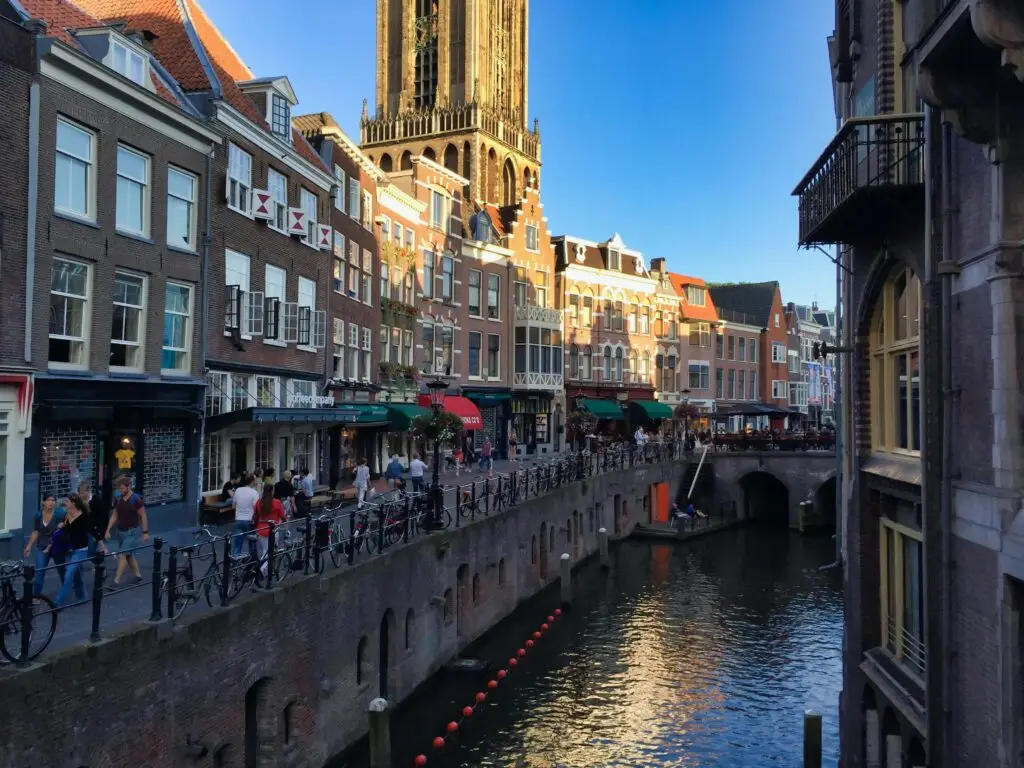
The Dom Tower located in the heart of Utrecht, standing as the tallest church tower in the Netherlands at an impressive 112m.

Utrecht Lumen glows as fully interactive light art piece. Utrecht artwork comprises 300 bulbs that shift color with the seasons and time of day.

Wilhelminapark spreads gardens and walkways through southern Utrecht. The pond sits peaceful, making this public park ideal for strolls.

Molen de Ster stands as Utrecht’s working windmill, open for public tours and visits. Step inside and learn about the history and construction.

Spoorwegmuseum houses vintage Railway Museum collections. The museum showcases railway equipment from decades past.
Dutch art and culture fill the Centraal Museum, where exhibitions span centuries of Dutch history across multiple galleries.


The local market, De Boerenmarkt, sells fresh meat, seafood and goods like cheese. In winter, visit the Christmas Market or try a Vegan Tour.
Climb Utrecht’s Dom Tower and feel the bells before you see the view.
Domplein sits 15 minutes on foot from Utrecht Centraal. Entry works one way only, a guided tour in Dutch or English, booked online or at Tourist Information, Domplein 9. Adult tickets run around €15, less for children and over-65s. Bags stay in free lockers. Clear days reward the climb most, pushing views beyond the city edge. Tours run all year except Christmas Day, New Year’s Day and King’s Day.
Masons followed John of Hainaut’s design from 1321 to 1382. Money ran out before the cathedral nave got buttresses. On the evening of 1 August 1674, a storm flattened that nave but spared tower and choir. Nobody rebuilt the nave, so tower and cathedral now face each other across open ground.
Inside, 465 steps twist up a tight spiral, with guides pausing at each landing to pick up the story. Sound arrives first. Fourteen swinging bells hang at 49 metres, where the Utrecht Bellringers Guild still rings them by hand. Galleries wrap the tower at 70 and 95 metres, the lower one level with the carillon. Freshly cut sandstone surrounds you, part of a roughly €40 million restoration that swapped in more than 10,000 blocks before finishing in November 2024. From the top, Utrecht’s rooftops and canals spread out below.
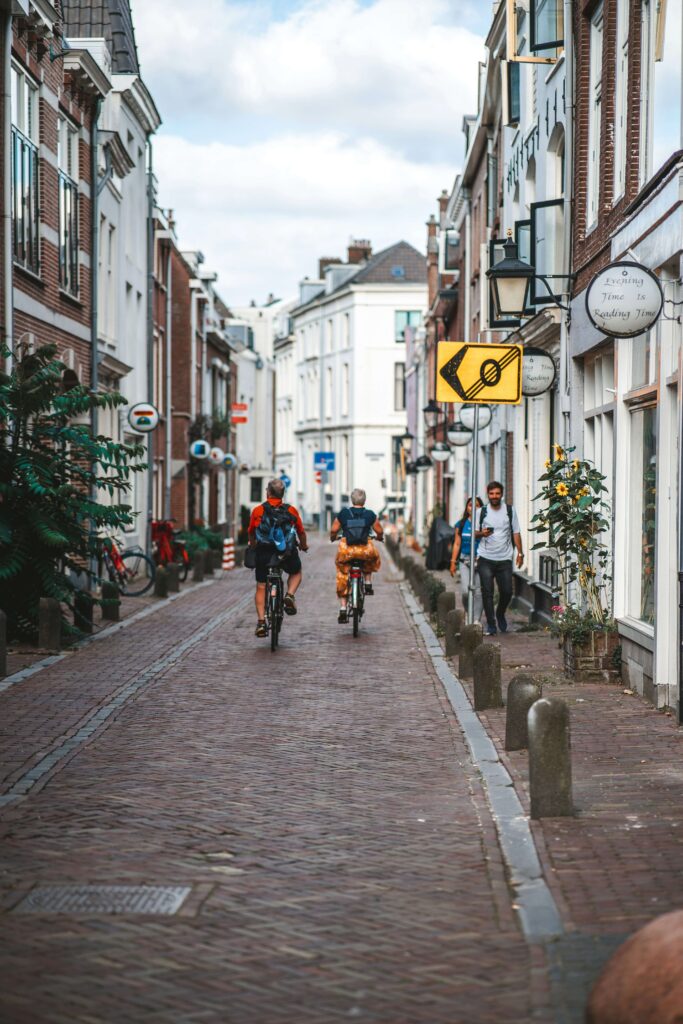
Back on Domplein, coloured bricks in the paving trace the missing nave’s exact floorplan. Cyclists cross the outline without a glance down, ringing their own bells at anyone who stops to look.
Amsterdam’s canals run along the street, while Utrecht’s run a full storey below it.
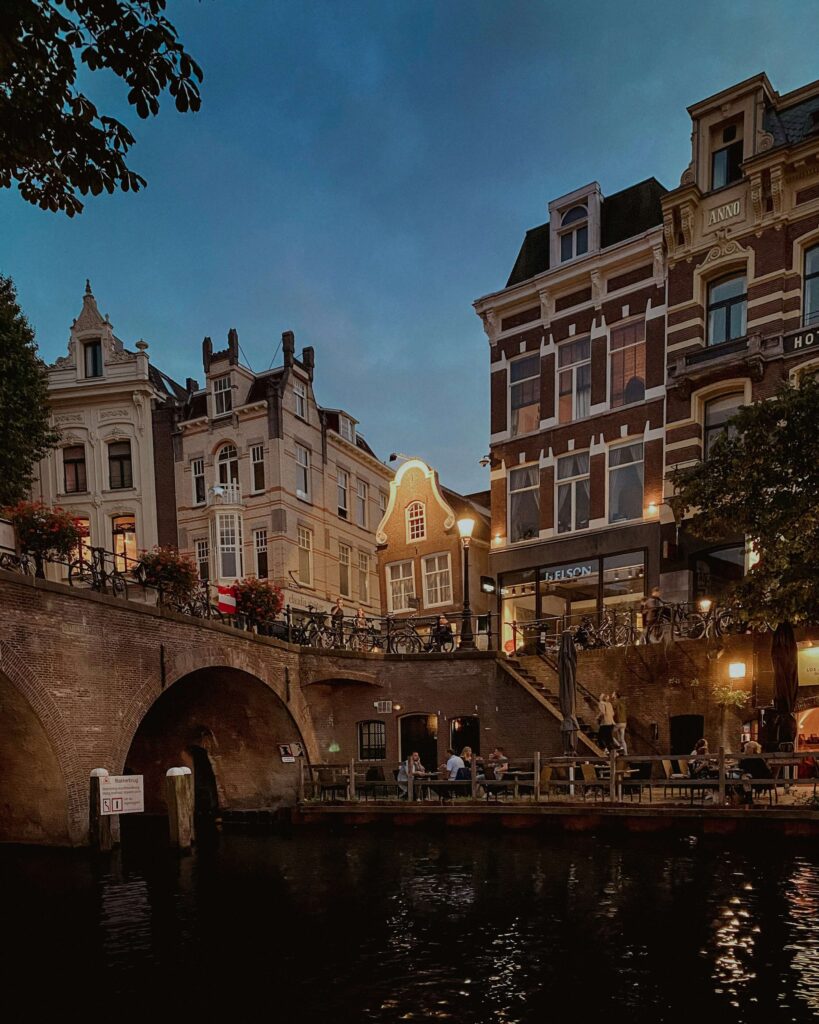
The Oudegracht cuts 2 kilometres through the old centre from south to north, linking the Kromme Rijn to the Vecht. Walking the full length costs nothing at any hour. Rederij Schuttevaer sails hour-long cruises from Oudegracht 85 for around €18. Terraces at water level fill up between May and September.
Medieval diggers cut the channel in sections through the 11th and 12th centuries to redirect the Old Rhine. The name Oudegracht came later, once the Nieuwegracht followed between 1390 and 1393. Merchants drove storage cellars, the werfkelders, under the street to the waterline so cargo moved straight from hull to vault. The cellars split the centre into two storeys, shopping street on top and working quay beneath. Today 732 of the originals still stand.
Take any staircase down and street noise drops away within a few steps. Bells, chatter and bicycle tyres carry overhead. Below them the Oudegracht runs at water level, where hulls knock against their moorings and cellar doors open onto terraces barely a metre above the surface. Five minutes east the mood reverses. The Nieuwegracht runs 700 metres past more than 100 monumental houses, six bridges and old trees, with almost no shopfront in sight. Households here kept their cellars private.
Back on the Oudegracht, under the town hall, a wharf tree grows inside an angular outline. From 1402 until 1837, the city crane hoisted cargo on this spot, until the last cast-iron caryatid bound for Winkel van Sinkel snapped the top clean off mid-lift.
Utrecht Lumen lights roughly 25 artworks across the old centre, each one visible only after dark.
The 3-kilometre route starts at the tourist office on Domplein 9. Nobody sells tickets or takes reservations. Lights switch on nightly at sunset and stay on until midnight. Guided walks in Dutch and English cost €12.50, though tours only restart in autumn 2026.
Mayor Aleid Wolfsen unveiled 18 works on 7 April 2010 as Trajectum Lumen, Latin for “Utrecht Light”. Dutch and international artists shared the route with students from the Utrecht School of the Arts. Tourist tax, European funds and Utrecht University helped cover at least €3.5 million. After years of lagging maintenance, the city reworked the route, now running as Utrecht Lumen.
Once shops close, bicycle bells carry farther than voices. From Domplein the route threads past Pausdam to Romanesque Pieterskerk, consecrated in 1048. Down in the Drift vaults, installations glow beneath street level while passers-by overhead rarely guess what shines below. At Janskerkhof, light lies across the square and pools under the trees. Farther on, the Ganzenmarkt tunnel, officially a wed, slopes down to Oudegracht wharves along the line horse carts once took. Erik Groen staged the ramp as a shadow play with that working past. Anyone stopping to photograph colour shifts soon blocks cyclists cutting through. Gabriel Lester’s work at the Buurkerkhof closes the walk, linking the city’s oldest parish church to the surrounding square.
Look down between installations. Small coloured arrows in the pavement light up after sunset, guiding walkers from one artwork to the next so the route needs almost no map. Not every arrow ends in light, since installations regularly sit dark or wait on repairs. The working pieces, however, turn an ordinary evening stroll into a free open-air gallery.
Wilhelminapark ranks among the first Dutch parks to win national monument protection.
The 1898 layout still sets the rhythm of warm afternoons in east Utrecht, more than 125 years after opening day. The grounds stretch east of the old centre, just past Oudwijk and no gate, ticket or closing hour stands between visitors and the grass. From late spring through early September, crowds claim the southern lawn. Winter freezes turn the central pond into the neighbourhood skating rink, whenever the ice holds.
Baron van Boetzelaer sold the land to the municipality in 1888 on one condition. The city had to lay out public walking grounds within 10 years. Hendrik Copijn won the design competition with an English landscape scheme and the park opened in 1898, right on deadline, to mark young Queen Wilhelmina’s inauguration. German occupiers later swapped her name for Nassaupark, a label that lasted exactly as long as they did.
Copijn’s English landscape scheme reveals itself best on foot. The main promenade runs the full length of the grounds while narrower paths curl off through more than 100 tree species. You hear the fountain before you spot the spray. Ducks patrol the shallows beside the queen’s statue. Villas and townhouses line the streets on either side, facing the grass so closely that the whole park reads as one shared front garden.
Near the western edge lies the park’s 1943 concrete bunker, built to shelter six men. German occupiers, the same ones who renamed the park, left the bunker behind. Today the shelter runs as EXbunker, where emerging artists hang weekend shows every month.
Most windmills grind grain, but De Ster eats trees.
Molen De Ster claims the island in Leidse Vaart, inside Lombok, eight minutes from Utrecht Centraal. Doors open Saturdays only, 1 to 4pm, while the cafe serves Wednesday through Sunday. Guided tours in Dutch or English cost nothing, though volunteers gladly accept donations toward upkeep.
Timber merchants built De Ster in 1739 as one of several sawmills working this stretch of water. Wind drove the saws until the early 1900s. Once electricity took over, the mill body came down. Decades passed before locals formed their own foundation, in 1988, to raise De Ster again. The rebuilt mill reopened in June 1999. Today, sails once more drive the saws, slicing timber as millers did.
Outside, three listed millers houses ring the lawn, beside sheds that hold stacks of drying planks. Chickens and goats share one pen next to the small playground, so younger visitors rarely run short of distraction. Terrace tables stretch right to the water’s edge, where warm Saturdays tend to wind down. Inside the mill, resin and fresh-cut timber scent the air. Overhead, wooden gears knock rather than whir, hinting at machinery hidden from view.
Climb the narrow ladder to the sawing floor, then glance down. Generations of hands have worn each rung pale at the center. Up top, the cutting mechanism lies open, with no glass or rope between visitors and blades. When wind cooperates, whole trunks creep through the frame saw at minute-hand pace. Planks take shape stroke by stroke, powered by nothing but moving air.
Spoorwegmuseum keeps 200 years of Dutch rail inside a station never fully closed.
Maliebaanstation, opened in 1874, houses the national railway collection across platforms, sheds and open track, 1 kilometre east of Utrecht’s old centre. Hourly shuttle trains leave Centraal from platform 2 and stop inside museum grounds, while buses run to nearby Stadsschouwburg. Doors open Tuesday through Sunday, 10am to 5pm, plus Mondays during Dutch school holidays. Admission costs €19.50 from age 4 upward, Museumkaart holders enter free and every visit requires timeslot booking.
Preservationists founded the museum in 1927, yet the collection reached Maliebaan only in 1954. Reconstruction between 2002 and 2005 recast the site as four themed worlds, Great Discovery, Dream Travels, Steel Monsters and Workshop, each mixing rolling stock with ride-style attractions.
More than 80 historic trains fill sheds and open track across the grounds, from steam and diesel locomotives to electric stock, carriages and trams. Signal box steps give sightlines over the yard. Younger visitors disappear into Jumbo Express, the theatre and rebuilt play area.
Most visitors cross the station hall only to buy tickets, then head straight for locomotives. Few look up at chandeliers over the restored hall or step into surrounding waiting rooms, where first, second and third class sit beside royal and dining rooms. Royal Class, open since June 2026, gathers royal carriages spanning almost 150 years. Versteeg’s Children follows Dutch railways under occupation. Outside, a 2015 monument commemorates Utrecht’s deported Jewish residents.
Centraal Museum spans 2,000 years of Utrecht, from medieval shipwreck to Miffy.
Doors open Tuesday through Sunday, 11am to 5pm, with Mondays closed. Adults pay €18, while Museumkaart holders and children under 13 enter free. Through 13 September 2026, the Gerard van Honthorst retrospective adds a €6 surcharge.
Dating from 1838, oldest municipal museum in the Netherlands settled into medieval Agnieten convent in 1921 and never moved again. Cloister walls still shape the route, so galleries open off stairwells and courtyard rather than one long axis. Nearly 18 metres of oak, built around the year 1000, waits at the bottom of the stairs.
Sixteen themed rooms upstairs put fashion beside painting. Viktor & Rolf gowns share walls with Utrecht Caravaggists such as Hendrick ten Brugghen, Abraham Bloemaert’s altarpieces hang metres from Moesman’s surrealism. Jan van Scorel represents the older Utrecht school, while Marlene Dumas and the Van Baaren collection carry the modern end. Rietveld’s furniture, the largest holding anywhere, anchors design rooms where the Red Blue Chair looks smaller than photographs suggest. Models of the Dom Tower and an old dollhouse track how the city grew. Second floor rebuilds Dick Bruna’s attic studio, his workplace through the final 30 years of his career, down to pencils, typewriter and fan letters around his desk.
Museumcafe and walled garden need no ticket. The museum library holds more than 50,000 titles. Researchers can consult them by appointment.
Rietveld Schröder House sits 20 minutes east on foot, under the same ownership. Slots open every 20 minutes, with the last one at 3.20pm. One combined ticket costs less than two separate ones.
Truus Schröder wanted no walls, so Rietveld gave her walls she could push aside by hand.
Prins Hendriklaan 50 stands 20 minutes east of central Utrecht on foot, or 5 minutes walk from De Hoogstraat stop on bus 8. Timed slots run Tuesday through Sunday, 11am to 4pm, closing for an hour at 1pm, plus Friday evenings until 9pm, from May through August. Adults pay €19, teenagers €10.50, museum-card holders nothing. Reservation stays compulsory regardless of ticket type. Stairs and tight doorways rule out wheelchair access.
Widowed in 1923, Schröder raised 3 children and wanted a home without walls. Rietveld, furniture maker crossing into architecture, went so far that planners passed the upper floor only once drawings called that level an attic.
Schröder remained until her death in 1985, after which Bertus Mulder restored the house. UNESCO listing followed in 2000, recognizing the revolutionary approach to domestic architecture.
Windows repay close attention. Every casement swings to exactly 90 degrees and stops, so open glass sits parallel with wall planes rather than breaking Rietveld’s geometry. Downstairs stays conventional, with kitchen, workspace and small sleeping rooms around a central stair. Colour appears only on rails, pipes and floor markings. Upstairs, staff slide partitions along tracks to convert one open floor into 3 bedrooms plus living room.
Centraal Museum operates the house and controls every time slot, with staff scanning tickets from an office to the left of the front door. The parent museum sits 20 minutes west and lends bicycles for the ride out, provided riders return them by 4:45pm. Media players in 8 languages pace each 35-minute visit.
Beatrix Theater stages musicals for months at a stretch inside a working trade-fair hall.
The Theater occupies Jaarbeursplein 6a, within the Jaarbeurs complex. Covered walkway runs from the station platforms to the theatre doors in about 5 minutes and trams 60 and 61 stop right outside. Doors open on performance days only, so the box office stays shut the rest of the week. Tickets start near €25 midweek and climb past €100 for prime weekend rows.
Beatrixgebouw dates from 1970, 29 years before any musical played inside. Architect Arno Meijs rebuilt the hall into a full-scale musical house, which Joop van den Ende opened in 1999 with Chicago. Stage Entertainment has leased the theatre long-term from Jaarbeurs ever since. The lease explains programming weighted toward big touring titles.
Arrive early and walk the foyers. More than 60 paintings, drawings and sketches hang on those walls, all by pop musicians, Paul McCartney, David Bowie, Ron Wood, Herman Brood, Barry Hay. Janine van den Ende assembled the collection with Christie’s Amsterdam. Nearly everyone walks past on the way to the bar.
Roughly 1,500 seats face a single wide stage, scaled for the productions that have run here: Mamma Mia!, Moulin Rouge!, Miss Saigon and Tina. Concerts, cabaret evenings and family shows fill the gaps between long runs. Daytime brings congresses instead.
Order interval drinks before curtain to avoid queuing at the bar. Anyone needing hearing support can borrow a radio-frequency receiver from the theatre shop on presentation of valid ID. Rows 19 to 22 spare visitors most of the stairs.
Three market days fill Vredenburgplein each week and De Boerenmarkt claims exactly one of them.
Every Friday, organic farmers move onto Vredenburgplein and sell Utrecht food that left their fields days earlier. Stalls open at 10am and pack down around 5pm, in the middle of the shopping district beside Hoog Catharijne. Nobody charges entry. Published closing times vary, so arrive before 4pm while tables still hold stock.
All trader holds Skal certification, Dutch organic licensing in force since 1987. Rebuilding work on Vredenburgplein through the 2010s pushed stalls around the square, yet farmers kept their Friday pitch.
Growers staff their own stalls, so no wholesaler stands between field and crate. Tables carry cow, sheep and goat cheese, vegetables, fruit, eggs, bread and pastry, juices, nuts, meat and sustainably caught fish. Stock turns with the Dutch growing year rather than with import schedules. Ask where your cheese came from and you get an answer from whoever made it, which supermarket aisles cannot manage. Utrecht’s general weekly market fills the same paving on Wednesdays, Fridays and Saturdays, so shoppers cross from bulk vegetables to certified goat cheese in a few steps.
Bring cash. Most stalls take cards as well, though not every one, so small notes save trouble at the cheese counter. Several traders welcome your own tubs and jars, which cuts packaging on the walk home. Cyclists leave bikes free of charge in municipal racks around the square. Drivers pay garage rates under Hoog Catharijne instead. Expect roughly €3.50 for a kilo of organic apples.
Here’s an outline from key locations:
Cars, buses and trains, the triumphant trio of travel. Providing a variety of choices:

For seamless travel, meet your flight-booking wizards.
Choosing accommodation is like selecting a travel companion—it shapes your journey.
Discover Cars, Buses, and Trains for a journey as memorable as your destination.
Online ticketing platforms have revolutionized travel and entertainment experiences.
Simplifying transactions and currency exchange for a smooth travel money experience.
Credit cards offer benefits like rewards and are useful for easy transactions or purchases.
Providing comprehensive coverage and protection for travelers globally.
Encrypting your connection, hides your IP address, and defense against cyber threats.