


De Pont Art Gallery exhibits modern works by renowned artists. Permanent collections share space with rotating ones throughout the year.

The Dutch TextielMuseum preserves history and artistry of Dutch textile craft. Nearly 25,000 artifacts trace the industry’s evolution through time.

Pieter Vreedeplein counts as Tilburg’s main shopping center. Stores, restaurants and entertainment pack the complex from end to end.

De Oude Warande translates into Tilburg’s oldest park. Lakes shimmer between trees, plants burst with color and cafes invite you to live longer.

Schrobbeler brews typical Dutch beer right here in Tilburg. Locals favor this drink at bars scattered throughout the city.

Tilburg Theater holds the title as largest theater in the city. Shows, concerts and events fill the calendar in the course of the year.

Tilburg houses Cinecitta movie theater, where cutting edge technologies project international films across multiple screens.

The Koningsplein Market draws Tilburg shoppers every week. Browse, taste cooked dishes and pick up fresh goods from local vendors.

Steam 013 Coffee & Cake lives up to its name, a coffee shop inside a real train coach. The favorite morning caffeine stop among locals.
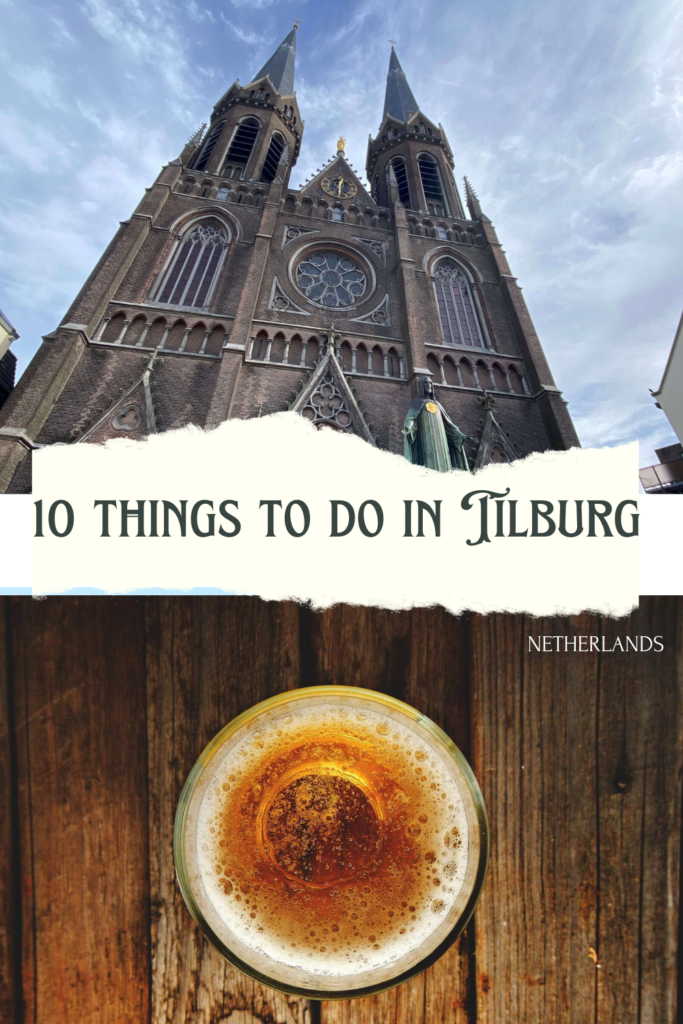
St. Joseph’s Church rises above Tilburg’s Heuvel square with two towers that make it impossible to miss and even harder to walk past without looking up. Standing on Heuvelring, the church welcomes visitors daily from 9am to 6:30pm. Weekday mornings generally bring the fewest visitors.
Construction began in 1871 but funding shortages divided the project into two phases before its completion in 1889. Architect Hendrik van Tulder based the design on French Gothic architecture, drawing particular inspiration from St. John’s Cathedral in Den Bosch. Both the church and its two historic organs are protected as Dutch national monuments.
High on the gable between the towers stands a copper-gilded statue of Saint Joseph, installed after the original was blown down during a storm in 1921. It’s an architectural detail that many visitors overlook while admiring the towers themselves.
Inside, four-part rib vaulting leads the eye towards the ceiling, where a late-1870s winged altarpiece anchors the high altar. Frescoes depicting the Stations of the Cross were added roughly two decades after the church first opened. Behind the rose window, a light installation completed in 2000 projects shifting patterns that change throughout the day as sunlight moves across the glass. The south tower originally housed a 35-bell carillon donated by parishioners in 1925, although the occupying Nazi forces removed the bells in 1943.
Before you even reach the entrance, a mirrored dome by Anish Kapoor catches you, made for the museum’s 25th anniversary and the first of his sculptures in Dutch public space. A 20-minute walk from Tilburg Central Station, the museum charges standard admission, visitors under 27 enter free. Every Thursday, doors open free from 5 to 8pm.
Lawyer Jan de Pont left part of his estate in 1987 to fund a foundation for contemporary art. The foundation set one rule: works had to be by living artists, nothing historical or heritage-listed. Benthem Crouwel Architects converted a Tilburg wool-spinning mill into a museum in 1992. A new wing followed in 2016 for photography and video work.
Walk into the main gallery and look down before looking up. Kapoor’s Descent into Limbo, a black disc sunk into the floor, reads as a bottomless hole, not concrete, locals call it “het zwarte gat”. Visitors stop at its edge, unsure whether to step around it.
The permanent collection doesn’t sit in one wing, instead it moves as you do. In the main hall, Richard Serra’s steel is suddenly there, heavy and close, Marlene Dumas’s fragile drawings wait beyond it. Ai Weiwei’s marble grapes sit near work by James Turrell, easy to miss if rushed. The old wool storage rooms, kept small, slow you and force a closer look. A separate space, WOOL, rotates emerging artists among established names. The garden closes the visit among apple trees and evening primrose.
TextielMuseum, the only place in the world where textile design, art, fashion, heritage and innovation converge under one roof.
The museum sits on Goirkestraat, a short walk from Tilburg’s center. It opens Tuesday through Friday from 10am to 5pm. On weekends, it opens at noon. Adult admission runs around €14.50, though Museumkaart holders walk in free.
The museum occupies a former 19th-century weaving mill that once powered Tilburg’s wool trade, back when the city counted roughly 145 wool mills at its industrial peak. Only a handful survive in this form today. This is the one still open to the public. Inside, the permanent collection splits across four threads: textile science, design, industrial heritage and art.
Most visitors photograph the old machines and move on, missing the smell along the way. The Woollen Blanket Factory exhibit still carries a faint mineral tang, left over from machinery that once cleaned, spun and wove raw wool between 1900 and 1940. No placard explains it. Stand close to the looms and it reaches you before anything else does.
At the center of the building sits the TextielLab, a working studio rather than a display case. Professionals load yarn onto machines here, in full view of visitors. They run lasering, tufting and embroidery projects on an active production floor instead of behind glass. Nearby, in the Damask atelier, restored looms demonstrate techniques passed down from a Brabant weaving company dating to the 1800s, while rotating exhibitions keep the floor from ever feeling frozen. Some come for the history, others for the design, but both leave having watched yarn become fabric instead of just reading about it.
Cars used to own this square. Now shops, cinemas and terraces do.
Pieter Vreedeplein sits in Tilburg’s Centrum district, a five-minute walk from Tilburg Central Station. Until the late 1990s the site was an open-air car park behind the old V&D department store.
In 1998, Tilburg’s city council partnered with a private developer to redevelop it. Shops opened in March 2008, adding 125 dwellings, 30,000 square metres of retail space and a seven-screen cinema above an underground car park, now listed at 780 spaces, among the largest in the city center. The square, named after Pieter Vreede, a textile manufacturer who ran a wool factory nearby from 1790 to 1802.
Around the clock, the public can access the square. Shops follow standard Dutch retail hours, with late-night shopping on Thursdays until 9pm. Sundays brings standard opening here, which remains uncommon in the Netherlands.
The paving uses two-toned granite slabs in alternating light and dark friezes. Seventeen granite benches are arranged across the square to spell out the letters of Pieter Vreedeplein, a detail most visitors walk past without noticing. A slender triangular tower marks the skyline above the arcade.
The retail mix skews toward Dutch and European chains. Media Markt handles electronics, Zara and The Sting cover fashion, Men at Work serves menswear, Bershka and Sissy Boy target younger shoppers, Sacha covers footwear and a Plus supermarket handles daily groceries. The PlayFountain, added more recently, covers 100 square metres with over 1,000 water jets, timed to lighting and music, running through the summer. Winter brings an outdoor ice rink and fairground rides to the same spot.
Eight avenues radiate from a single point, carving a seventy-hectare forest into perfect geometric quarters and almost nobody in the travel world is talking about it.
The park lies south of the Tilburg–Breda railway line, between Tilburg University station and the Reeshof district. Free entry and the park stays open year-round, with no ticket booth and no dress code to worry about.
In 1712, Willem van Hessen-Kassel obtained permission from local magistrates to convert roughly sixty hectares of common land into a private hunting and pleasure ground, drawing inspiration from André Le Nôtre, the architect behind the gardens at Versailles. The community lost that land for almost nothing. Three centuries later, they have it back.
Most visitors walk the shaded lanes without noticing what the ground itself is hiding. A Tilburg zoo once occupied part of this land between 1932 and 1973. When it closed, its Siberian ground squirrels escaped into the forest. Their descendants still live here, unmarked by any signpost.
At that central point, the geometry becomes immediate: Callum Morton’s Grotto Pavilion sits there, a mirrored glass structure designed to be nearly invisible that doubles as an art installation and a cafe, open from April through November. Since 2000, the Lustwarande Foundation has used the park as a platform for contemporary sculpture, adding rotating works that surface in unexpected clearings throughout the woodland.
The smell hits before anything else at Schrobbeler: forty-three herbs steeping somewhere behind the tasting room on Polluxstraat.
Schrobbeler, a Dutch herbal liqueur born 1973 in Tilburg, tells you more about this city than any museum pamphlet will. Find the distillery on an industrial estate on the edge of town, reachable from Tilburg Centraal by a short bus ride rather than a stroll. Tours run every Saturday and Sunday, though booking ahead through the official website is required. Entry covers three hours of guided experience, including tastings and live music.
Jan Wassing, a local entrepreneur with a sensitive stomach, began blending his own remedy for Carnival and serving it to friends from his home bar, which he called “Bij den Schrobbelaar”. The name referred to the wool carder, a textile worker central to Tilburg’s industrial past. After Jan died in 1981 at 51, his son Pieter-Jan made sure the recipe wasn’t lost, carrying it forward with the help of a local distiller. The family still runs the operation today.
The liqueur contains 43 different herbs, though the precise blend remains a family secret. Recognizable notes include star anise, cinnamon and cloves. Surprisingly, garlic, which is undetectable but enhances the other flavors. Served ice-cold and neat, being warming and peculiar at the same time. The ANWB, the Dutch touring association, voted this tour the best day out in North Brabant.
Theaters Tilburg joins two performance halls behind one glass facade, staging everything from stand-up comedy to symphony orchestras.
The complex sits at Louis Bouwmeesterplein, a 15-minute walk from Tilburg Centraal, with buses 1 and 2 stopping at Stadhuisplein nearby. Ticket prices vary by show, from a cabaret seat to a full musical stall. No dress code applies beyond what the evening itself calls for.
The building’s story starts long before its 1961 opening. City planners floated the idea of a proper theater as early as 1910, but funds ran short, so an old textile mill served as a makeshift stage through the interwar years. Architects Bernard Bijvoet and Gerard Holt finally delivered the Schouwburg in 1961. The concert hall followed in 1996 under Jo Coenen’s design. In 2015 the building received rijksmonument status, the Dutch equivalent of a listed national heritage designation.
Step inside the Concertzaal and look up. Peter Struycken’s lighting installation washes the ceiling in shifting color, a detail most visitors miss until they’re already seated. The seat count runs to roughly 850 in the Schouwburg alone, spread across a main floor and two balconies facing a 21-meter stage.
Programming leans wide rather than niche. The season brings more than 300 live performances and concerts, plus hundreds of film screenings, spanning cabaret, dance, classical music and touring musicals. Expect a mixed-age crowd depending on the bill.
Cinecitta, the oldest continuously operating cinema hall in the Netherlands, housed inside a protected national monument in the heart of Tilburg.
Find it at Willem II Straat 29 downtown, taking walk-ins for most screenings while dinner packages need a reservation. Films screen in their original language with Dutch subtitles, though English subtitles appear on Thursdays. Ticket prices vary by film, a two-course dinner-and-movie combination lands around 32 euros.
Traveling companies first screened shorts here in 1904 in the concert hall of the Souvenir des Montagnards. A permanent cinema opened on the site on 13 October 1916 under the name De Nieuwe Bioscoop, later cycling through identities as Cinema Royal, Camera and Ambassade before becoming Cinecitta in 1983. Followed by a major restoration in 2012, earning the building second place in the NRP Gulden Feniks restoration prize, behind only the Mauritshuis.
Cinecitta receives no structural government subsidy, it survives entirely on ticket sales, sponsorship and donations. Such independence quietly shapes every programming decision made here.
Inside, the halls are compact and plush, seating built for comfort rather than volume. Staff will let you carry a glass of wine into your seat. Signature dine-in nights ask guests to eat almost entirely in the dark, plates arriving mid-film so taste, not sight, takes over as the guide. Programming skips Hollywood in favor of arthouse imports, retrospectives and the occasional comedy night.
Saturday morning, Koningsplein smells like fresh herring and old regret. One comes from the market that fills the square twice a week. The other comes from the mayor who flattened an entire neighborhood to build it.
The square sits in the Centrum district, a short walk from Tilburg’s main train station. Entry costs nothing. The market runs every Friday from 9am to noon and Saturday from 10am to 4:30pm. Saturday is the main event, arrive between 10am and noon to catch full stalls and the best selection.
Most people crossing the open pavement never stop to consider what lies beneath it. When Tilburg’s wool industry collapsed in the 1960s, Mayor Cees Becht cleared the old Koningswei neighborhood, ruled a slum, to make way for something modern. Architects Van den Broek and Bakema designed Koningsplein to pull the city’s gravity toward it. It never did. People kept drifting back to the old center. Instead, the square earned a reputation as Tilburg’s ugliest almost immediately. Decades later, the verdict still holds, on non-market days, it feels hollow, a monument to ambition that never found its footing.
Saturday changes everything. Dozens of stalls crowd the space with organic vegetables, fruit, regional specialties, farmhouse goods, handmade crafts, textiles and clothing. French dried sausages, aged cheeses and fish appear regularly. Watch how Tilburg residents shop: purposefully, unhurried, pausing to argue affectionately over whether the strawberries are ripe. That back-and-forth is the real theatre here. Underground parking sits directly beneath the square, so logistics stay simple.
The best cup of coffee in Tilburg comes from a wagon that hasn’t moved in years.
The address is Burgemeester Brokxlaan 6, a five-minute walk from Tilburg Centraal station. Seating fits barely a dozen people, so weekday mornings offer better odds of a table than weekend afternoons. The cafe opens from 8:30am and draws both locals and the occasional confused tourist who stumbles in from the skate park next door. Prices sit comfortably in the affordable range for the Netherlands.
The name nods to 013, Tilburg’s phone area code. The carriage sits inside a district the city spent two decades converting from a disused rail yard into a cultural quarter. The wagon predates that transformation entirely, the coffee culture built around it is new.
Inside, the counter still traces the carriage’s original curve, forcing baristas to work elbow to elbow in a space narrower than most home kitchens. The kitchen rotates its focus, brownies and poppy seed cake anchor the counter, none of it over sweetened and all of it baked to complement rather than compete with the coffee.
Beans are sourced from Boca AMS, an Amsterdam specialty roaster with reputation. The latte art is precise, the cakes land somewhere between comfort and craft. The tea arrives in a brewer that regulars describe as unlike anything they’ve tasted elsewhere.
Here’s an outline from key locations:
Cars, buses and trains, the triumphant trio of travel. Providing a variety of choices:

For seamless travel, meet your flight-booking wizards.
Choosing accommodation is like selecting a travel companion—it shapes your journey.
Discover Cars, Buses, and Trains for a journey as memorable as your destination.
Online ticketing platforms have revolutionized travel and entertainment experiences.
Simplifying transactions and currency exchange for a smooth travel money experience.
Credit cards offer benefits like rewards and are useful for easy transactions or purchases.
Providing comprehensive coverage and protection for travelers globally.
Encrypting your connection, hides your IP address, and defense against cyber threats.